Showing posts with label reading. Show all posts

7.8.20

"The Long Forgotten" by David Whitehouse - Review


David Whitehouses „Mobile Library“ was probably the first review copy I ever got, back in 2015 when I just started my book seller apprenticeship. It was also the first review I wrote for my bookshops website. And I was lucky, because I had come across a rare gem back then, so the memory of this first venture into my profession happened to be a very good one. I am still holding “Mobile Library” very dear, partially for nostalgic reasons but also because it was a brilliant book.

Now when you have read and loved someones debut novel, a second book being published is equally exciting and scary – your expectations are high, so there is plenty of room for disappointment. But like with most things in life, there is just as much room for things to go well.

I will admit it, it took me shamefully long to pick up “The Long Forgotten”. Not only because reading isn’t part of my job anymore and therefore, I find very little time in my day to day life to do so, or because my pile of shame is so much higher than I’d like to admit (but I will: Currently 55 books). I also was scared to be disappointed.

I was wrong, and I have never been this happy about being wrong in my entire life.

On the first glance, in “The Long Forgotten”, David Whitehouse tells not one story but three and at first it seems odd since these people do not seem to be connected in the slightest: Dove, an odd-ish young man from London with anger issues and memories that are not his own. Peter Manyweathers, a cleaner from New York in the 1980s who is swept away by a sudden obsession with botany. Professor Cole, a grumpy scientist who stumbled across the black box flight recorder of the lost flight PS570 in an incident that almost cost him his life.

These stories seem to be only connected by them being unlikely enough to be of interest but just likely enough to actually happen. For the sake of a spoiler-free review I will only say: They are connected, and it is astonishing how. Please do read the details yourself.

David Whitehouse has a talent to make the reader fall in love, with his language, with his characters and especially with whatever subject he decides to write about. I have never been this passionate about rare flowers and botany before. I have never related this much to an orphan curious to find his parents. And I certainly have never felt that much interest in cleaning in my entire life and hope to get some great accomplishments from this newly found and most likely shortlived obsession.

Whitehouses habit to find and portray the magical in the most mundane, to tell stories of such wonder in an every day life setting that you inevitably start to view your own life through completely new eyes, is remarkable. Personally, I hope to read much more from him.

20.6.17

Books to read to make you feel better

Reading can help a lot with things, I think if you, dear reader, found this humble blog, you propably know that already. Throughout my life, I struggled with a lot of different things, from things as simple and survivable as break-ups up to actual depression. And even though I tend to prefer books about the saddest, heartbreaking topics, there are some that helped, either anyway, or because I picked up something carefree for once. I will not go as far as pretending books could cure mental illness, rest assured, but what I am going to say is that personally, I found peace in reading books that are supposed to make you happy, I found calm within pages as I found useful advise from time to time when characters went through things comparable to my own situation at this point. So I don't guarantee for anything, but here are a few books that help bring me up again when I am feeling down and maybe they can help you too.

"Hectors Search For Happiness" by Francois Lelord

 See, this is one of those carefree books. The style of writing is very pure as if Hector wasn't a grown-up psychiatrist but, well, a little boy viewing the world as a very happy place to begin with (which propably makes his search for happiness easier). The movie with Simon Pegg and Rosamund Pike is very recommendable too, even though it is a lot more realistic because we rather watch Hector on his journey than seeing the journey through his own eyes.
I read this book when I just started my apprenticeship and the town I newly moved to was still a bit scary and strange and I was just starting to get a bit better after the really dark few months - it did help me with my recovery, and I still like to watch the movie on bad days (and cry like a happy little baby in the end).


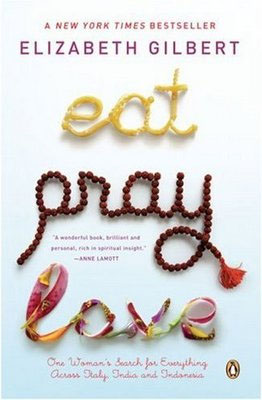
"Eat Pray Love" by Elizabeth Gilbert

Another book turned into a movie, but this time, for the love of god, please don't watch the movie (or, if you have already, don't let the movie stop you from reading the book). I came to read this pretty coincidentally, I got a used copy somewhere for free and thought "okay, this is said to be a so called 'womens book' (=aka cheesy and lovey dovey and just not my type of books), but it's hyped a lot, so let's see what all the fuss is about, after all it's free"- this one one of the luckiest coincidences in my life so far (and I do have a lot of lucky coincidences).
"Eat Pray Love" is non-fiction but still pretty much written like a novel. It is about Elizabeth Gilbert herself recovering from her divorce by spending a trimester each in Italy (where she basically eats her own body weight in pizza and pasta to enjoy wordly things), India (where she joins an Ashram to embrace spirituality) and on Bali (to find a way to combine both). I read this book when I was recovering from a pretty rough break-up myself and found some useful advise on how to deal with my own feelings in the way Elizabeth dealt with hers, as well as advise on how to go about my love life in the future. I have since been a lot more chill about dating, so this book actually had a long-term positive influence on me.

"The Alchemist" by Paulo Coelho

 I actually just finished this book last week, I picked it because it's a classic and pretty short (less than 200 pages) so it was a nice read after I finished "The Blackthorn Key" and waited for the second Blackthorn book to be released. "The Alchemist" isabout following your destiny and your dreams and having trust that somehow, everything will work out.
After realizing that the next two months will be rough financially and being frustrated with the infamous German bureaucracy, this book really calmed me down - it's right, I will survive this and everything is going to be so much better after going that one last mile on my way to a life with a new, well-paid job and a new flat etc. "I'll be okay, even if everything sucks from time to time" is the message this book shouts in your face.


Other examples would be the Harry Potter books, for example, or "Ronia, the Robbers Daughter" by Astrid Lindgren, just books from my childhood in general because they always take me back in time a bit to a time where things were just easier. Of course that wouldn't work for everyone, but it works for me, and I'm glad reading helps me cope. Do you have books as well that you keep going back to when everything sucks?

7.6.17

"The Blackthorn Key" by Kevin Sands - Review


Christopher Rowe is extremely lucky in an otherwise unfortunate life – after growing up in an orphanage he gets the opportunity to become an apothecary’s apprentice and ends up with Benedict Blackthorn who is probably the only apothecary in London in 1665 who would never beat him. He studies hard, the recipes and how to encode them, and he finds a father figure in Master Benedict who tries to bring his curiosity under control when he almost blows up the apothecary shop again with one of his unauthorized experiments. Actually, everything could be perfect, if it wasn’t for the mysterious murders that keep happening in the city – the victims primarily being apothecaries. Christopher worries for his master and a race against time begins where he has to try, with the help of his masters codes, to lift the secret of the murderers.
Kevin Sands’ debut “The Blackthorn Key” is an exciting mix of adventure, crime and a tad of fantasy that gets a slight historic spin from its setting. Young Christopher Rowe and his master grow close to the reader very quickly, the other characters are designed with a lot of love as well, and the plot is worked out with loads of details and pretty much impossible to solve by yourself. “The Blackthorn Key” is recommended for children between 10 and 13, but the now grown up Harry Potter- and Bartimæus-fans will probably like it just as much.

10.2.17

"The Keeper Of Lost Things" by Ruth Hogan - Review


Many people collect something in their free time. Stamps, coins, rocks, books... but it's a lot rarer you hear about people collecting lost things, things they find somewhere. Writer Anthony Peardew is such a person. Ripped off coat buttons, umbrellas and a mysterious cookie tin filled with ashes, Anthony keeps everything, puts a label on it stating when and where he found it and tries to give it back to its original owner. He does all of this to compensate for a lost locket he once got from his deceased love Therese.
When Anthony dies he leaves his house and his whole fortune to his assistent Laura – and with it the task to bring back the lot things to their rightful owners. Laura doesn't feel like she could handle that but she gets help from Freddy, the garderer she's secretely in love with, and Sunshine, a girl with down syndrome who lives in the neighbourhood that hardly ever leaves her side.
Throwback to 1974: Young Eunice starts working as an assistent to the attractive publisher Bomber. They share a big passion for movies and an incredible love for dogs and Eunice instantly falls in love with him. But she knows that they will never be a couple and instead she stays at his side as a trustworthy friend, both at the publishing company and in their private life where she helps him facing his sister who is spoiled by a big inheritance and doesn't understand why Bomber refuses to publish her shamelessly plagiarized manuscripts.
In her first novel „The Keeper Of Lost Things“, Ruth Hogan neatly puts those two plots together without being too intrusive – the full extent of the link is only revealed on the last pages. Both stories are full of British humour, heartwarming moments and a little bit of mystic. Lauras story is also bristles with short stories about the lost things in Anthonys possesion – if they are from the writers imagination or the actual backround stories is up to the reader. All that makes „The Keeper Of Lost Things“ a light summer read without too much kitsch that should delight fans of David Whitehouses „Mobile Library“.

23.1.17

So you want to become a bookseller.

Ever since I started my apprenticeship in 2014 and started working as a bookseller, friends of mine (and friends of friends, and friends of friends of friends, and...) started stating that they would like to become one, too - or at least they heavily considered it.
I am not in the age anymore where you get all defensive about people doing your thing - in fact, I only started working in this field because I met my ex who is a passionate bookseller, told me about his job and gave me the opportunity to try it out at the shop he works at. When I hear people telling me that they want to do what I do, I feel like I am following in his footsteps, and since he is an amazing person with remarkable work ethics and so much love for what he does, I'd be proud if I was.
Thig is, I always feel like my job is not portrayed correctly. Not even by me. Of course I tend to only post/tweet about the nicr stuff. The moments that warm my heart and reassure me that I made the right choice. A lot of people seem to think that as a bookseller, you're mostly a bibliophile who gets paid for reading and gushing about books with customers - which is not inherently wrong, but simply not the whole truth.
To be very, very honest: I have seen a lot of people starting to work in this field and get disappointed, then frustrated, then quit because it is not what they expected.
And even though I love my job, my reality is very different to the reality of other booksellers (mostly due to a great team of coworkers and our amazing, kind customers) - and even I don't always love it.
To be very honest again: If it wasn't for my awesome colleagues and people in my life I can vent to, I wouldn't speak of my work half as fondly in public.
Now all of this may sound like I wanted to unsell becoming a bookseller to people. I really don't! But I think people should get disillusioned so they can choose this job without false expectations.
So here is a few tips and experiences that you should consider while considering a bookshop as your working place:

1. Think bookselling is reading and loving books for a paycheck? Think again!
As I said, my reality is really different to others. Yes, in my shop I get to read at work sometimes, and I get to gush about books I liked with customers. But this is an absolute exception. A lot of the other booksellers I know don't. It really depends where you're working. In a big chain? Forget it! In a small shop there might be the chance, but usually, there is too much to do. Because bookselling is, in the end, a retail job like any other retail job. There are things to be organized, shelves to be stocked, shelves to be cleaned, there is just so much to do most of the time. That I get to read is only due to the fact that I am still an apprentice and thus not qualified to do some of the work behind actually running a bookshop, and even then, it rarely happens that I am finished with everything and it's a quiet afternoon so I can spend time between customers reading. In fact, I am pretty sure that, once I started my next job, I'll have to go back to only reading in my free time.

2. Selling books is hard physical work!
This is also something that differs depending on where you work, but every shop has deliveries from publishers and wholesalers, and that means: hauling, hauling, hauling! If you are not at least a bit fit, either get fit or give up on that idea. Especially if you work for a shop that equips schools with textbooks, you'll be able to spend days just carrying tons of books from A to B and back. It's exhausting, and you will come home in the first few weeks and just fall asleep as soon as you went through the door. Promise!

3. Selling books is hard mental work!
Jup, it's both. This point is actually two points. First, it is mentally exhausting because you have to think a lot. You have to calculate a lot of stuff, even with the most mundane tasks you'll have to be fully concentrated because if you make one mistake you might be sending your company right into insolvency, and you have to be a true Sherlock Holmes, which brings be to the second point. If you work retail, it's inevitable that you will come across customers that will be very demanding. "I don't remember the title [nor the author nor the publisher nor anyting that might be actually something I can put in my catalogue to look it up] but the book was blue!" isn't a well-known phrase amongst booksellers for nothing. Or you get titles that are completely messed up from what they actually are. Or you get "You know, that English textbook for year 7!" Mate, there are literally a few hundred of those. Finding what your customer actually wants is something that will happen. Often. And you need to think, think, think. And, if you're lucky, remember all the books you ever saw in your life (not read, saw). And the ones your whole family, all your friends and your coworkers read. Being a catalogue on legs is helping a lot. I am still working to get to that point at some day right before my retirement.

4. It's not for introverts.
By that, I don't mean introvert as in having to recover all for yourself after spending time with people to charge your social battery again. I am that kind of introvert, and it's fine, really. I mean introvert as inbeing shy, being sensitive, generally prefering to be left alone. Soft skills are key in this field. You'll come across a lot of different kinds of people at work, and it is vital to treat all of them well, from the elderly highly-intellectual person over the soccer mom over the loud overly-excited lover of crime fiction over the sci-fi nerd to the small child who wants to spend their pocket money on Diaries Of A Whimpy Kid. No matter how they treat you. Keep smiling, stay polite, even if the soccer mom yells at you for ordering the exact English textbook for year 7 she pointed at the other day in your catalogue to be the book she needs that turned out to be the absolute wrong book for her childs class. This is hard as well, and you need to be thick-skinned to get through that. Luckily, I can say that, for me, that happens about... once a month, maybe? But those moments are hard, and it's a huge learning process to get to the point where you stop taking it personally and just get over with it. Just smile and wave - and vent to your coworker once there are no customers in the shop anymore.

5. It won't make you rich.
In fact, I am glad we have minimum wage in Germany, because when I finished my apprenticeship, if I work the same hours as I do now, I can comfortably survive on minimum wage as long as I still only have to feed myself. Bookselling is not a well-paying field. I compared wages with my boyfriends field the other day, and his entry wage will be my absolute top - ya know, in case I ever start my own company and it does well.
To be a bookseller, a Spongebob-like work ethic is helping a lot - you know, that episode where he pays Mr Krabbs for letting him work at the Krusty Krab? That. Being a bookseller is being an idealist. If you don't love the job enough that'd you'd do it for free, don't consider it.
 
If at this point you still think that sounds like a lot of fun - congrats, you have what it takes to be an awesome bookseller, and I'd be happy to have you as a colleague some day! Because, and this is important: In the end of the day, no matter how long and exhausting it was, no matter how much my back and my head hurt, I still wouldn't want to do anything else. Being a tad masochist helps, I guess.
I would still recommend, if possible, to do an internship at a bookshop first. Try it. Actually live it for a week or two and see how it feels. I am still not sure if I would be as enthusiastic about it if I didn't know what I got myself into beforehand. Maybe I would've been disappointed as well.
I am so very glad I wasn't.

9.1.17

"I'll give you the sun" by Jandy Nelson - Review

The twins Noah and Jude are inseperable – both are interested in art and have an artistic disposition but apart from this they are rather different. Noah, who draws, is closer to their mother, and the sewing and sculpting Jude has a better relationship with their father. Noah is an introvert original while Jude is popular and spends a lot of time with her surfer friends at the beach. Still, they are hand in glove with each other – until puberty hits and everything changes. Both want to attend the Californian School of Arts, and thus a rivalry for the mothers attention and support forms who seems to be somewhere completely else mentally. Noah discovers his homosexuality and doesn't really know how to deal with it, Jude herself makes first experiences with love, and slowly, the siblings grow apart more and more, become stranger to each other, and when their mother dies in a car accident, their connection is lost for good.

All of this is told from 13 years old Noahs point of view. Three years later, Jude tells us about the current situation where the twins' roles seem to have switched: Jude is attending art school, is seclusive, hardly cares for friendships and keeps boys away from herself, whereas Noah is cool and popular but gave up drawing. They hardly talk to each other. Jude has a hard time sculpting in school, all her clay works break mystically. She believes that her dead mothers ghost is so angry with her that she is breaking her works. Jude wants to make up for something, and for that she needs stone, a statue, and a mentor to teach her statuary. She finds that in the bizarre artist Guillermo – and with him, she finds Oscar, a mysterious English boy who makes it hard for her to hold her boycott on boys up.

Incredibly sensitive and gentle Jandy Nelson guides us through the exceptional twins' emotions. The subject of the siblings who love each other but still are in concurrence to each other is rarely found in young adult fiction in a way this unique. Jandy Nelson combines family drama, LGBT+ literature, coming of age story and, yes, a love story and manages to find an own style that is hardly comparable with other authors.

23.12.16

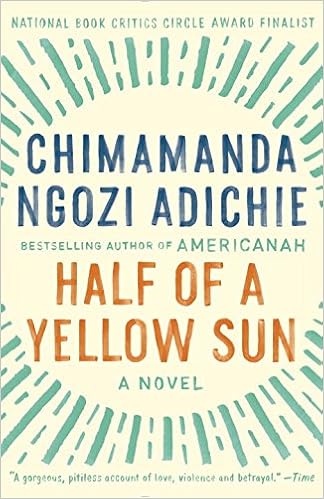
"Half of a yellow sun" by Chimamanda Ngozi Adichie - Review


The newly acquired independence of Nigeria from the Commonwealth involves new problems. The population is split over how the country should be governed. Many intellectuals still see a strong bond to the former colonial ruler Great Britain, and between the different tribes is discord as well, because when you speak of Nigerians you don’t speak of a homogenous people but a loose affiliation of different peoples whose only common ground is that between the borders of their nation.
Now that the Nigerians are supposed to govern themselves, each of those tribes is afraid of being overlooked, and Nigeria turns into a powder keg. History is made quickly, a military putsch is pulled through mainly by Igbo, one of the three biggest tribes in Nigeria. That results in the persecution of the Igbo who get murdered in masses by people of the other tribes. 1967 at last, in the South-East of the country, the republic Biafra is declared, a nation supposed to protect the Igbo and make them independent from Nigeria. What follows is a bloody war between both countries and a blockade that coins the image of the biafran malnourished child with a bloated belly forever before Biafra is reincorporated after the capitulation in 1970.
In “Half of a yellow sun”, Chimamanda Ngozi Adichie bluntly and impressively tells the story of three people during the rise and fall of Biafra. The link between those people is the university docent Odenigbo who fights for Biafra passionately. We witness the story from the point of view of his wife Olanna who falls from the life of a privileged daughter of a rich family into a life in poverty in a refugee camp during the war, the point of view of the houseboy Ugwu who is intellectually fostered but also influenced by his master and yet always keeps a little jungle in his heart, and from the point of view of the British journalist Richard who, after living as a stranger in Nigeria, finally feels home in Biafra – and still isn’t, due to his skin colour and origin and the privileges coming with that.
With “Half of a yellow sun”, Adichie, who is an Igbo herself, makes a part of history visible that ususally is overlooked by the Eurocentric world view and the habit to let the winners write history and yet manages to not force a onesided view upon the reader by being fully aware of both the flaws of Biafra as well as the injustices that were committed by Nigeria and the rest of the world. Additionally, with the social entanglements between Olanna, Odenigbo and Richard and their families, she makes up a thrilling and captivating family story.

 “Half of a yellow sun” makes this part of history understandable especially to those who never heard the word Biafra. Helping with that is a glossary at the end of the book.

6.12.16

"The Rain" by Virginia Bergin - Review


We look for it on other planets, consist of it approximately two thirds, and the prognosis is that in a future not too far away we may have to fight wars about it: Water is THE premise to sustain life, from the smallest organism to the biggest. But what happens if such an important substance suddenly turns into the most dangerous thing in the world?

In Virginia Bergins Thriller „The Rain“ the teenager Ruby Morris has to make just that experience. So far, living well-protected in sleepy Darthbridge in south-west England, her only worries are her stepfather she often fights with, her crush Casper and iffy Saskia who tries to take him away right in front of her. Puberty. The fact that a few years ago a giant meteorite was bombed right before hitting Earth atmosphere isn't exactly bothering her either. But this exact meteorite brought a diabolic bacterium when it rained down in tiny pieces all over the planet. It is hyperresistent, it links with water, it multiplies rapidly, and it kills its victims within just a few hours.

Ruby has to realize quickly that this tiny thing from outer space is able to turn her whole world around. Friends? Dead. Family? Propably also dead. Energy? Blackout. Showering? Forget it. And the biggest problem, of course, is thirst. The supplies of safe drinks are drained quickly, and other, stronger, armed people are not going to share anything.

Virginia Bergin describes this extreme situation, this postapocalyptic chaos vividly and realisticly. With great care she considers every consequence of such a plague and does't fear partly unsavoury scenes. That the protagonist is a 15-years-old girl is a well-made effect (because in no phase of life the own problems seem to be so much more important than others), but sometimes a bit exhausting (same reason). But that doesn't disturb the appeal of the story as a whole at all – I won't leave my home without a umbrella for some time.

6.11.16

"Girl on the Train" by Paula Hawkins - Review

Not everyone likes crime fiction. But that really doesn't mean you can't read them. For those who don't like classic detective stories „Girl on the train“ by Paula Hawkins is very good to go.

In „Girl on the train“ we observe a crime from three perspectives: Annas, a overly happy wife who just got her first child, Megans, the victim, and Rachels. Rachel is divorced, living with her room mate for far longer already than originally planned, she is an alcoholic and already lost her job because of her addiction. The one thing she has besides that are the daily train rides from the suburbs to London. On those rides the train always stops for a moment at the exact same pace and she can see a house through the window with an obviously very happy couple living there. She calls them Jess and Jason and builds an illusion around who those people are that she is only watching from afar and that mean so much to her. Until, one day, Rachel sees something strange that really doesn't fit into that illusion, and just a bit after that a missing person report with a photo of Jess is published – except her name is Megan. Rachel wants to help, and doesn't only get tangled up in a net of lies she actually doesn't even have anything to do with, but she also has to deal with Anna and her husband, Rachels ex-husband, who live just a few blocks away from Jess and Jason and are not very fond of the drinking, miserable Rachel not just leaving them alone.

With „Girl on the train“, Paula Hawkins managed a brilliant debut that readers can't let go of. She shows an absolutely human quirk of big city residents – observing and de-humanizing others – and puts it into a thrilling, complex, thought-through story with a main character that you will pity and admire at the same time. Rachel is a wonderful anti-hero you just can't help to love despite her muffed life, and „Girl on the train“ is a book very fit for non-crime fiction readers and fans by Gillian Flynns „Gone Girl“.

30.10.16

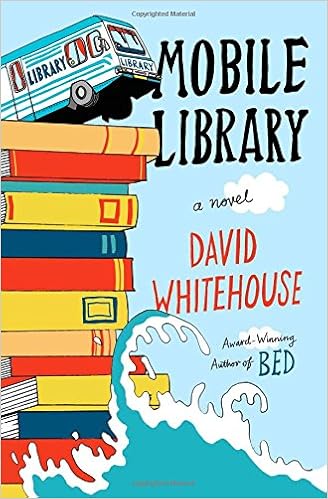
"Mobile Library" by David Whitehouse - Review

A single mum, her daughter and a boy steal a mobile library – David Whitehouses book „Mobile Library could almost be summarized like a bad joke, as absurd but also unique the scenario is in which his characters find each other. Bobby Nusku is the child of a loveless father and wants to find his best friend whom he made a cyborg, Rosa Reed has trisomy 21, Valerie, Rosas mother, instantly feels responsible for that strange boy her daughter likes so much and who treats her daughter just like everyone else. She wants to protect him from his father, and when the mobile library she cleans one a week is about to be shut down, the three of them sense an adventure: They steal the bus and go on a wild road trip across Great Britain, the police always upon their heels.

Most of all things, “Mobile library” fascinates with its blunt take on real problems that lot of people like to turn a blind eye to, be it problems that come with disabilities, bullying, abuse or suddenly losing your job which can happen to anyone. David Whitehouse knows his craft: he puts all this off-putting truths in a contrast to beautiful fantasies, to the fact that you can lose yourself in stories and that they are able to comfort and distract when it is truly needed. As direct and honest this novel is, it just as well is a declaration of love to literature and fantasy itself, so as a bookworm you can't help to fall in love anew with thousands of classics and every book that ever meant something to you. Due to the road trip through the UK, a smack of adventure is added to this already pretty appealing mixture, making this book a masterpiece well and truly.

28.10.16

"Maggot Moon" by Sally Gardner - Review


Standish Treadwell is 15 years old and he can neither write nor read. Because of that, people view him as stupid while actually, he is really clever. In the eyes of the government compliant teachers, classmates and neighbours he is worthless, because of his dyslexia and because of his different-coloured eyes, because of his unusual name and everything in general that makes him so different from the proud citizens of his home country who see themselves as superior human beings. They won the war, raised to global power, and in a few days they are going to land on the moon, equip it with nuclear weapons and gain unlimited respect from the other nations once and for all.

Standish despises his home country since it took his parents and also his best friend Hector and his parents. He lives alone with his grandfather who struggles to keep both of them from starvation with great difficulty. Standish dreams of traveling to the country of Croca-Cola some day where everything is colourful, and drive around in an ice creme blue Cadillac with Hector. Everything would be better when he made it out of the rundown zone 7.

When Standish finds the moon man in his basement, a member of the moon excursion team, just after Hector disappeared, his life is turned upside down.

„Maggot Moon“ is set in a fictitious worst case scenario: What would have happened if not the allied forces but the Nazis won world war two? If not the USA but the Third Reich wanted to send the first man to the moon? One can indeed call it a dystopian concept, but what makes it special is that it is set in the past in 1956.

The author, Sally Gardner, is dyslexic herself, only learned to read and write when 14 years old – and she proves with her young readers book „Maggot Moon“ that this is in no way an obstacle for making something great. She follows the dystopia trend in the manner of classics like „1984“ by George Orwell and more recent works like the „Hunger Games“ series by Suzan Collins but skillfully and innovatively interprets the topic in a wholly own way that clearly distinguishes this book from others. Standish Treadwells rebellion is not a loud one, not a bloody one, but silent, considerate and peaceful. As paradox as it seems, his weapons are words and truths, as he puts it, the pebble bringing the giant to the fall. Due to the short chapters that rarely exceed two or three pages the novel reads without effort and fluently.

Visually, „Maggot Moon“ is a true eyecatcher as well: Besides the cover being designed with great devotion the pages are a flicker book showing a rat and a fly having a whole different story. Those illustrations are what makes the book a double work of art.